

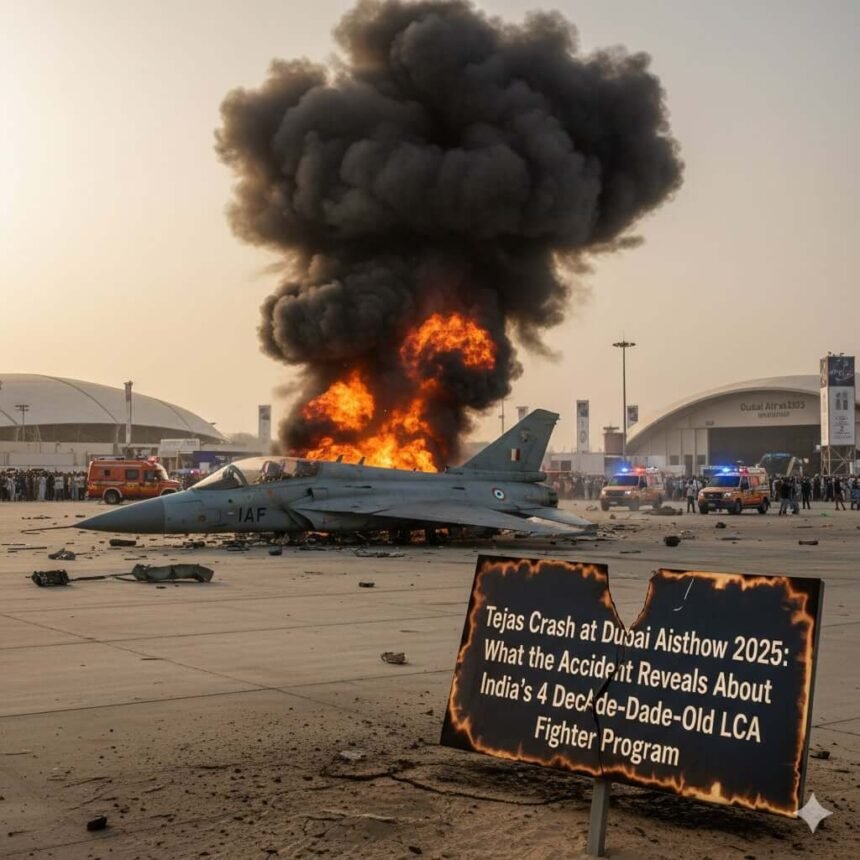
Introduction: A Spectacle Turned Tragedy
The Dubai Airshow is one of the world’s most prestigious stages, a sun-drenched intersection of commerce and military might where nations showcase their finest aerospace innovations. It is a place for multi-billion-dollar deals, high-stakes diplomacy, and breathtaking aerial displays that project national power and technological prowess. For India, the 2025 show was a critical platform to market its flagship indigenous fighter, the Tejas Light Combat Aircraft, to the world.
On November 21, 2025, that showcase turned into a global spectacle of a different kind. During a scheduled aerobatic display, an Indian Air Force (IAF) Tejas fighter jet suddenly plunged from the sky, pancaking into the ground in a deafening impact and erupting into a fireball. The demonstration of prowess had become a public disaster, broadcast across the world in real-time.
The crash had an immediate and devastating human cost: the death of the pilot, Wing Commander Namansh Syal, a highly experienced aviator chosen for this high-stakes demonstration. But as the smoke cleared, it became apparent that this tragedy was more than just a mechanical failure or a moment of pilot error. It was a dramatic public event that ripped the cover off deep, long-standing issues that have plagued India’s most important indigenous fighter program for decades.
1. The Ominous Prelude: A Public Reassurance Followed by Disaster
Just days before the fatal accident, a minor controversy had already placed the Tejas under a microscope. Videos began circulating on social media platforms, purportedly showing a Tejas aircraft on the ground at the airshow with an “oil leak.” The claims, amplified by propaganda accounts, aimed to cast doubt on the fighter’s reliability. However, several aviation observers attending the show also noted that, earlier in the week, a small support crew was seen assessing what some described as a “minor fluid leak” beneath a Tejas aircraft.
India’s official Press Information Bureau (PIB) Fact Check unit moved quickly to debunk the social media narrative. Officials publicly clarified that the visuals did not show a technical malfunction. Instead, they depicted a routine and intentional procedure of draining condensed water from the aircraft’s systems—a normal operation in humid environments like Dubai. It was condensation, not a critical fluid leak.
This sequence of events made the subsequent crash catastrophically damaging. On the very stage where officials had just quelled rumors of technical flaws, the aircraft suffered a fatal accident in front of a global audience. The crash, regardless of its ultimate cause, gave instant and powerful validation to the very concerns India had tried to dismiss. The official response from the Indian Air Force was swift but somber, acknowledging the gravity of the incident on the world stage.
“IAF deeply regrets the loss of life and stands firmly with the bereaved family in this time of grief. A court of inquiry is being constituted, to ascertain the cause of the accident.”
2. A Four-Decade Dream Becomes a Public Nightmare
The Tejas program, which began in the 1980s, has long been the centerpiece of India’s “Make in India” initiative and a powerful symbol of its ambition for self-reliance in combat aviation. It was conceived to replace the aging fleet of Russian MiG-21s and establish a sovereign fighter-manufacturing capacity. However, the path from concept to combat readiness has been a torturous one, marred by systemic failures that were thrown into sharp relief by the Dubai crash.
The program’s history is a case study in technical setbacks and institutional challenges. For those who have followed its development, the crash was not an anomaly but a tragic manifestation of unresolved issues. These include:
- Developmental Delays: The Tejas has been in development for nearly four decades. This prolonged timeline has been plagued by shifting design requirements, technological gaps, and an inability to freeze a final, stable configuration, leaving the aircraft in a perpetual state of evolution.
- Quality Control Problems: Reports from within the program have long pointed to recurrent quality control issues at Hindustan Aeronautics Limited (HAL), the state-owned manufacturer. These defects include persistent fluid leaks, panel misalignments, premature wear on seals, and grounding issues that compromise the fleet’s safety and reliability.
- Engine Integration Difficulties: The Tejas was originally intended to be powered by an indigenous engine, the Kaveri. When that project failed to meet performance targets, India was forced to rely on imported General Electric F404 engines. This mismatch has created a host of performance limitations, as the foreign engines were not optimally suited for the Tejas’s airframe, leading to thrust limitations and increased maintenance complexity.
The high-profile failure in Dubai was not an isolated incident. It was the public culmination of deep-rooted challenges that have haunted the program for years, turning a symbol of national pride into a public relations nightmare.
3. A Pattern of Peril: The Single-Engine’s Point of Failure
Any single-engine fighter jet operates with an inherent and unforgiving risk: a propulsion system failure, especially at low altitude during high-stress maneuvers, can become an unrecoverable catastrophe. There is no backup engine to provide thrust, leaving the pilot with seconds to react in a situation where altitude and airspeed are rapidly diminishing.
The Dubai crash tragically highlighted this vulnerability, but it was not the first time the Tejas’s engine reliability had been called into question. On March 12, 2024, the Tejas fleet suffered its first-ever crash near Jaisalmer, India. While the pilot in that incident ejected safely, preliminary investigations pointed directly to a critical technical fault: an engine seizure caused by an oil-pump malfunction.
Having two crashes in less than two years—both raising serious questions about the single engine’s reliability under stress—fundamentally alters the program’s narrative. Before these incidents, the Tejas was praised for its excellent safety record. Now, what was once an impressive record is viewed as a worrying pattern, particularly as eyewitnesses in Dubai described the aircraft either failing to recover from a “negative-G turn” or losing power during a “steep climb.” This suggests the propulsion system may have a critical point of failure when pushed to the absolute limits of its performance envelope.
4. When National Pride Meets High-Stakes Risk
The Tejas Light Combat Aircraft carries more than just munitions; it carries the immense political and symbolic weight of India’s “Aatmanirbhar Bharat” (self-reliant India) initiative. As the flagship of the nation’s indigenous defence industry, there is enormous pressure to present it as a world-class competitor on the global stage.
According to defence analysts, this political imperative may have dangerously overshadowed technical prudence. The desire to project technological strength and secure export orders led to the decision to demonstrate the aircraft at the very edge of its performance envelope through high-G, low-altitude aerobatics. This high-risk display was pursued despite a documented history of quality control issues, known engine integration difficulties, and the alarming precedent of an engine seizure causing the fleet’s first-ever crash just 20 months prior. In short, the need for positive “national optics” appears to have led to the acceptance of a foreseeably high technical risk.
The crash in Dubai, therefore, has consequences that extend far beyond the loss of a single airframe. It jeopardizes the aircraft’s export ambitions, providing ammunition to competitors like China’s JF-17. More profoundly, it places the credibility of India’s entire military-industrial complex under intense international scrutiny, raising questions about whether the nation’s push for self-reliance is being managed with the necessary rigor and attention to safety.
Conclusion: Beyond the Wreckage
The tragic crash of the IAF Tejas in Dubai was not just an accident; it was a symptom of deeper, systemic challenges that have defined the program for decades. The incident was a painful convergence of historical development delays, unresolved technical vulnerabilities in its single-engine design, and immense political pressure to perform on a global stage.
The ultimate cost of these issues was paid by Wing Commander Namansh Syal, an exceptional pilot whose loss underscores the real-world consequences of these systemic failures. His death is a solemn reminder that behind the strategic ambitions and industrial targets are human lives that depend on uncompromising standards of safety and technical readiness.
As investigators analyze the wreckage, the critical question for India is not merely technical, but strategic: can its ambition to project power on the world stage be reconciled with the discipline required to build it, or will the pursuit of “national optics” continue to place its pilots, and its credibility, at unacceptable risk?