

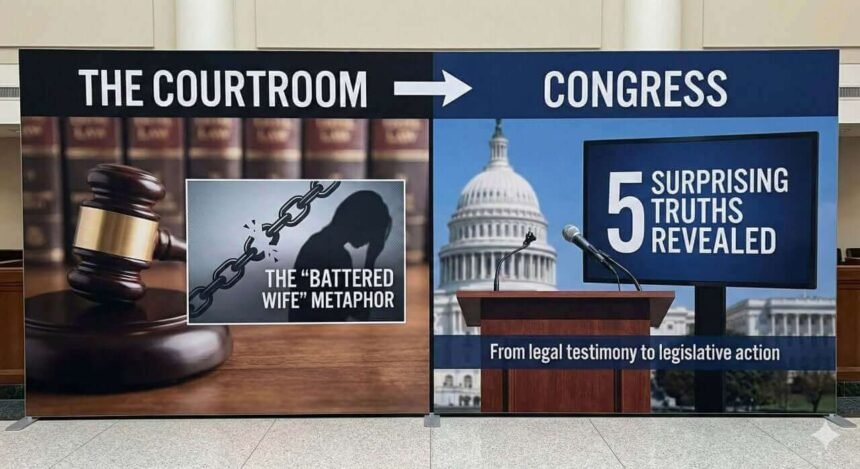
Introduction: A Political Firestorm and a Buried Legal Truth
When Representative Marjorie Taylor Greene used the provocative “battered wife” analogy to frame her political break with Donald Trump, it ignited a predictable media firestorm. The soundbite was instantly dissected as a piece of political theater. But beneath the surface of the political spin lies a much deeper and more complex reality: the decades-long struggle within the American legal system to understand and justly adjudicate cases of self-defense for victims of domestic abuse. Greene’s calculated rhetoric is not just a political statement; it is an entry point into a profound legal debate about fear, control, and the very definition of self-preservation. This article explores five surprising truths that connect this political metaphor to a long, and often tragic, legal history.
1. The Imminence Trap: Why Killing a Sleeping Abuser Isn’t Considered Self-Defense
To understand why the American legal system so often fails battered women, one must first grasp its obsession with a single, ticking moment: imminence. The law of self-defense was not built to see a continuous threat; it was designed to see a snapshot—a fist raised, a knife drawn. For many courts, if the danger isn’t happening in that exact frame, it isn’t happening at all.
This strict application of the law creates a legal trap for victims of domestic abuse. It fails to account for the cyclical and terror-inducing nature of battering, especially in what are called “non-traditional” self-defense scenarios. If a victim kills her abuser while he is asleep, or during a temporary lull in the violence after he has made a credible death threat, many courts will rule that the danger was not “imminent” and therefore disallow a self-defense claim entirely.
The legal system often focuses on a single, isolated moment rather than the broader context of ongoing terror that defines an abusive relationship.
This article posits that many courts have engaged in an overly rigid application of the imminence requirement in the law of self-defense by looking at a single moment—when the women actually strikes the fatal blow—rather than looking at a broader spectrum of time and context in which the killing occurred.
It is this specific, time-bound legal anguish—the inability to act until the moment of attack—that makes Greene’s casual use of the metaphor for a slow-burning political dispute so jarring.
2. A Law Built for Bar Fights, Not “Domestic Terrorists”
Traditional self-defense law was constructed around a distinctly male-centric model of aggression. It imagines a one-time confrontation between strangers of roughly equal power—the classic bar fight scenario. It was not designed to address the unique and terrifying dynamics of an intimate, long-term abusive relationship where one person systematically dominates and terrorizes another.
The source legal analysis draws a powerful and disturbing parallel between international terrorists and domestic abusers. Both use unpredictable threats and violence to create a state of “hypervigilant fear” and “chronic fear” in their victims. The abuser becomes what the author terms a “domestic terrorist,” someone who seeks “to control and diminish lives by threats, physical harm, and the creation of uncertainty about how and when the potentially lethal harm will occur.” This reframing is crucial because terrorism is understood as a state of ongoing, chronic threat, which directly counters the law’s myopic focus on a single, “imminent” moment of attack. This state of constant dread is fundamentally different from the singular threat of a barroom brawl, yet the law often struggles to see the distinction.
3. The Radical Idea: Using International Law to Redefine Self-Defense
Given the shortcomings of domestic law, some legal scholars have looked to an unlikely source for a better model: international law. Specifically, they point to the doctrine of “Anticipatory Self-Defense” (ASD). In international relations, ASD allows a nation to act defensively against a specific, known, and imminent threat before an attack is fully underway. As the legal text explains, “a country need not wait until the missile is in the air.”
The core proposal is that a carefully limited version of this doctrine could provide a more rational and just framework for self-defense in domestic violence cases. This proposed domestic ASD would only be available under specific circumstances: (1) there is a prior history of serious physical abuse; (2) the abuser has made a statement of intent to kill or cause serious harm; and (3) the abuser has taken any action in furtherance of the threat or is in the physical proximity of the woman at or shortly after the time he makes the lethal threat.
This is a carefully “cabined” approach and is explicitly distinguished from the much broader and more controversial “Bush Preemption Doctrine,” which the legal analysis argues “stretches the concept of ASD to the point of lawlessness” and is an inappropriate model for either international or domestic law.
4. The “Syndrome” Defense: A Tool That Can Pathologize Victims
Many people are familiar with the concept of “Battered Woman’s Syndrome” (BWS) as a legal defense. It was introduced to help juries understand the psychological state of abuse victims. However, legal experts argue that this defense has significant and often counter-intuitive limitations.
First, the science behind BWS is described as “scientifically suspect.” More critically, the defense can backfire in the courtroom by raising the “implication that the woman who killed was not acting rationally, but suffered from a mental illness.” This is a critical flaw, as it shifts the legal argument from one of justification—”I took a rational action to save my own life”—to one of excuse—”I was not in my right mind and couldn’t help myself.” Justification argues the act was right; excuse argues the actor was broken. Instead of seeing the victim’s act as a reasonable response to a terrifying situation, the BWS defense can frame her as mentally damaged and incapable of sound judgment.
A Missouri court case bluntly summarized this damaging perception, reinforcing the idea that the victim is inherently broken rather than rationally responding to terror:
“[a] battered woman is a terror-stricken person whose mental state is distorted.”
5. From Legal Anguish to Political Spin: When “Battered Wife” Becomes a Strategy
This brings us back to the political arena. On November 21, 2025, after a public and irreconcilable conflict with Donald Trump, Representative Marjorie Taylor Greene announced her resignation from Congress, effective January 5, 2026. To frame her exit, she reached for the very metaphor at the heart of this complex legal debate, stating:
“I refuse to be a ‘battered wife’ hoping it all goes away and gets better.”
By framing her conflict in this way, Greene preemptively answers the political version of the classic victim-blaming question, “Why didn’t you just leave?” Her analogy is a calculated performance of self-preservation, designed to control the narrative by co-opting the language of trauma. This was a calculated political move. The analogy was strategically deployed to transform what was a voluntary political retreat into a profound moral stand. It leverages the deep emotional power of abuse narratives to reframe her departure not as a concession of political defeat in the face of a primary challenge, but as a necessary act of self-preservation undertaken with dignity. She co-opted the language of victimhood to seize control of the political narrative, casting herself as the one who chose to leave a toxic situation rather than the one who was forced out.
Conclusion: A Metaphor We Can’t Afford to Misunderstand
The journey of the “battered wife” metaphor—from a complex legal concept rooted in the anguish of victims to a sharp-edged tool in the political arena—reveals how deeply the dynamics of abuse and self-preservation are woven into our culture. We have seen how the law struggles with concepts of time, terror, and rationality, and how those same concepts can be strategically manipulated for political gain. What is lost when the legal language of sustained, life-or-death terror is stripped of its context and repurposed for momentary political advantage? Does it merely empower a speaker, or does it risk deafening us to the authentic pleas of those for whom the danger never truly sleeps?

